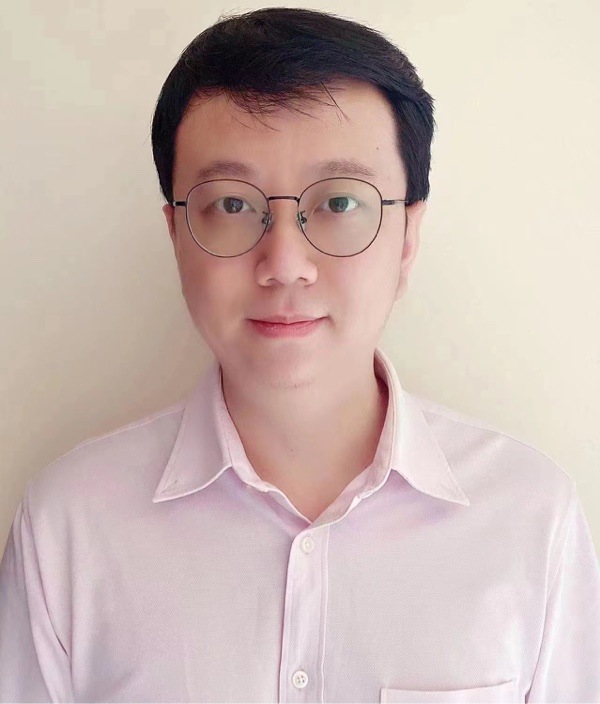
Keynote Speaker
Prof. Saman Halgamuge The University of Melbourne, Australia Biography: Prof. Saman Halgamuge, Fellow of IEEE, IET and AAIA, is a Professor in the School of Electrical, Mechanical and Infrastructure Engineering. He served as a distinguished lecturer/speaker of IEEE (2019-21), Director/Head, Research School of Engineering of the Australian National University (ANU) (2016-18), a member of Australian Research Council (ARC) College of Experts (2016-18), the founding Director of the PhD training centre Melbourne India Postgraduate Program (MIPP) of University of Melbourne and Associate Dean (2013-15) and Assistant Dean (2008-13) in International Engagement in the Melbourne School of Engineering.
|
Prof. Saleh Mobayen University of Zanjan, Iran Biography: Prof. Saleh Mobayen received the B.Sc. and M.Sc. degrees in Control Engineering from the University of Tabriz, Tabriz, Iran, in 2007 and 2009, respectively, and received his Ph.D. in Control Engineering from Tarbiat Modares University, Tehran, Iran, in January 2013.He has been a Visiting Scholar at the Faculty of Engineering, Design and Mathematics in the University of the West of England (UWE Bristol) in 2019. Since December 2018, He is Associate Proffesor of Control Engineering at the Department of Electrical Engineering of University of Zanjan. He has been recognized as one of the Top 1% Best Researchers in the field of Engineering in 2018 and 2019 (Listed by Essential Science Indicators (ESI)).He is the Top Researcher of Faculty of Engineering, University of Zanjan, from 2015 until now. |
A. Prof. Dong Li Macau University of Science and Technology, Macau, China Biography: Prof. Dong Li, associate professor in School of Computer Science and Engineering in Macau University of Science and Technology(04/2022 – Present) , reasearch focusing on area in Next-Generation Wireless Communications; Communications for Internet of Things; Machine Learning for Intelligent Communications. He is now an IEEE Senior member, Member of IEEE Communications Society(2010–present), also as an executive board member of IEEE Macau Section(2016–present). He is also the Expert Reviewer for High-Level Talents in Guangdong Province (06/2021 – Present), Expert Reviewer for National Science and Technology Award (05/2021 – Present). |
Prof. Ting Yang Tianjin University, China Biography: Prof. Ting Yang, doctoral supervisor, is a discipline leader in the School of Electrical and Information Engineering, Tianjin University. He is the deputy director of the national "distributed energy and micro grid" international science and technology cooperation base and the deputy director of Tianjin "Energy Internet” International Joint Research Center. As the largest contributor, he has won two provincial and departmental science and technology progress awards and some enterprise science and technology progress awards. He has published more than 100 SCI/EI papers, 4 monographs and 2 international invention patents in top academic journals in China and abroad. He has served as the session chair of several IEEE international conferences. He also served as the editor in chief or member of the Editorial Committee of several SCI journals. He is the special editor in chief of "Application of artificial intelligence in power system and energy Internet"(which won him the "Outstanding Special Editor Award" in 2018) of “Journal of Power System Automation”, and the special editor in chief of "Ubiquitous Power Internet of Things (UPIOT)" of “Journal of Power Construction”. He is now the deputy director of circuit and system branch of China Electronics Society, the national director of sensor sub committee of China Instrumentation Society and a member of the theoretical electrician special committee of China Electrical Engineering Society. His main research interests include energy & power, Internet of things, artificial intelligence and intelligent manufacturing. |
Prof. Daowen Qiu Sun Yat-sen University Biography: He has published over 130 papers in peer-review journals, and over 25 conferences papers. More specifically, (1) He has systematically studied a number of different QFA (quantum finite automata) models, and solved the decidability of equivalence and minimization of these QFA models. In particular, we have answered the problems of how to minimize QFAs proposed by Moore and Crutchfield. Also, he has studied some properties of 2QFAC, quantum pushdown automata, and quantum Turing machines. (2) He has proved the characterization of all Boolean functions that can be solved by quantum 1-query algorithm. (3) He has studied quantum states discrimination and quantum cloning machines, and he has derived some bounds on unambiguous discrimination and minimum-error discrimination (some bounds are optimal to a certain extent), and some relationships between unambiguous discrimination and minimum-error discrimination have been clarified. Also, he has established a generic machine model of probabilistic cloning and deleting, and proposed a universal probabilistic deleting machine. (4) He has studied quantum teleportation and superdence coding based on different entangled states (W-states). (5) He has studied semi-quantum cryptography and proved that a semi-quantum key distribution protocol is unconditional security. (6) He has discovered some essential connections between quantum logic and models of computation, and he has established residuated lattice-valued automata theory. (7) He has established a fundamental framework of the supervisory control for fuzzy discrete event systems (FDES). |